
MemoryFuel Supplement Facts: The Panel Transcribed, Decoded and Checked Against the Ads
The jar's Supplement Facts panel is the only legally binding description of what is inside MemoryFuel. Here it is line by line, with the arithmetic behind each percentage, the scoop-weight math, and the places where the marketing says something the label does not.
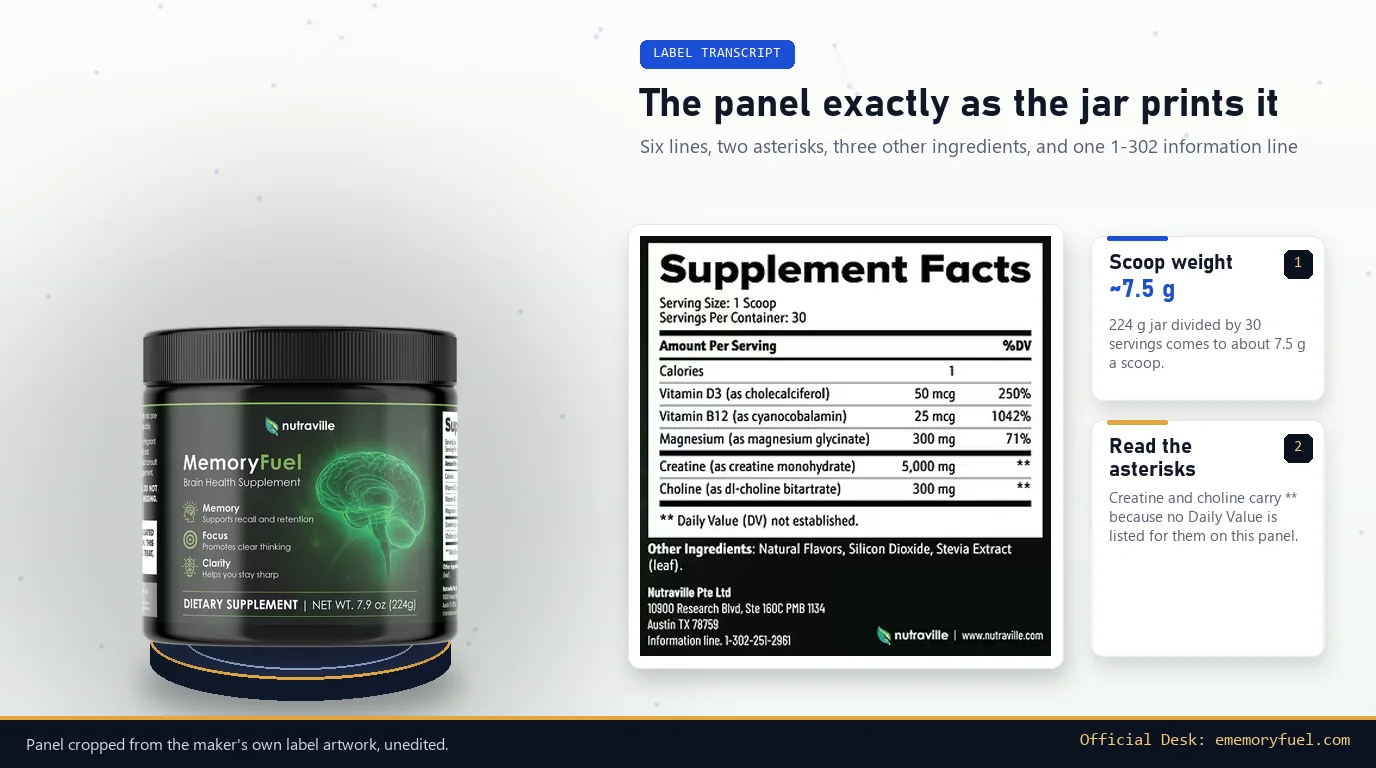
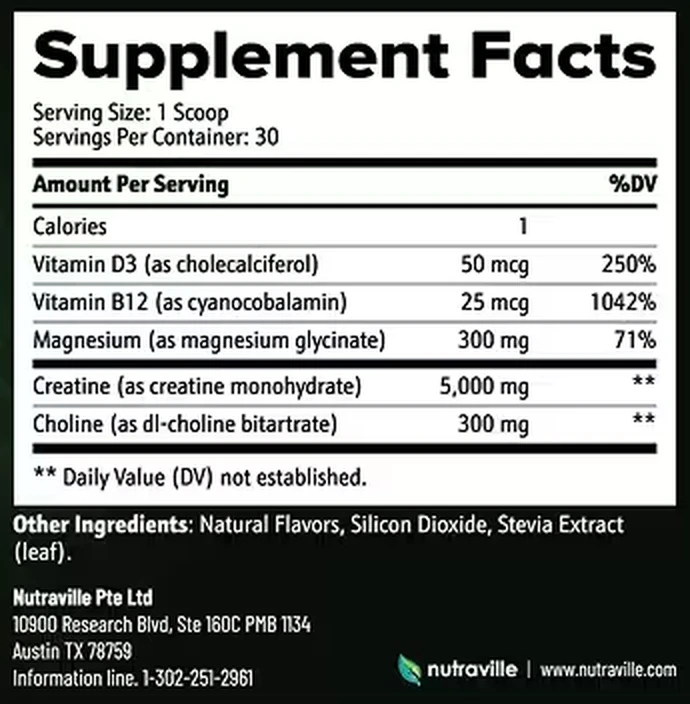
The panel, transcribed
This is the Supplement Facts panel from the maker's own label artwork, reproduced line for line. The jar in your hand should match it exactly; if it does not, see the jar inspection page.
| Serving Size: 1 Scoop · Servings Per Container: 30 | ||
|---|---|---|
| Amount Per Serving | %DV | |
| Calories | 1 | |
| Vitamin D3 (as cholecalciferol) | 50 mcg | 250% |
| Vitamin B12 (as cyanocobalamin) | 25 mcg | 1042% |
| Magnesium (as magnesium glycinate) | 300 mg | 71% |
| Creatine (as creatine monohydrate) | 5,000 mg | ** |
| Choline (as dl-choline bitartrate) | 300 mg | ** |
** Daily Value (DV) not established. Other Ingredients: Natural Flavors, Silicon Dioxide, Stevia Extract (leaf).
Suggested use: As a dietary supplement, adults mix one (1) scoop with 6-8 oz. of water or favorite beverage daily. Caution: Do not exceed recommended dose. Pregnant or nursing mothers, children under the age of 18, and individuals with a known medical condition should consult a physician before using this or any dietary supplement. Keep out of the reach of children. Do not use if safety seal is damaged or missing. Store in a cool, dry place.
The manufacturer block reads: Nutraville Pte Ltd, 10900 Research Blvd, Ste 160C PMB 1134, Austin, TX 78759, information line 1-302-251-2961, with the nutraville.com web address. The front reads "MemoryFuel, Brain Health Supplement", "Dietary Supplement", "Net Wt. 7.9 oz (224g)", with three structure-function lines: memory supports recall and retention, focus promotes clear thinking, clarity helps you stay sharp.
Line by line: what each number means
Federal rules require a supplement panel to list each dietary ingredient with its amount per serving, and to show a percent Daily Value for nutrients that have one; ingredients without a Daily Value get a symbol pointing to a footnote.[1] Read with that in mind, each line tells you something.
| Line | Amount | %DV printed | Reference used | Desk note |
|---|---|---|---|---|
| Calories | 1 | Stevia, not sugar, sweetens the drink | ||
| Vitamin D3 (cholecalciferol) | 50 mcg | 250% | DV 20 mcg | Half the 100 mcg adult upper limit |
| Vitamin B12 (cyanocobalamin) | 25 mcg | 1042% | DV 2.4 mcg | Only a few mcg absorbed per dose |
| Magnesium (glycinate) | 300 mg | 71% | DV 420 mg | Elemental magnesium; just under the 350 mg supplement UL |
| Creatine (monohydrate) | 5,000 mg | ** | No DV exists | Standard maintenance dose |
| Choline (dl-choline bitartrate) | 300 mg | ** | DV 550 mg exists | Asterisk suggests the figure may be the salt weight |
The percentages check out arithmetically for vitamin D3 (50 / 20), B12 (25 / 2.4) and magnesium (300 / 420), which tells you those figures refer to the nutrient itself, as the rules require.[2] The choline line is the outlier. Choline has had an FDA Daily Value of 550 mg since the label reform, so 300 mg of choline should appear as 55%. Printing a double asterisk instead suggests either an outdated label template or that 300 mg is the weight of the bitartrate salt, about 123 mg of actual choline. We describe this as an open question rather than an error because only the maker can settle it.[8]
Scoop math: 224 g, 30 servings, 7.5 g each
Dividing the net weight by the number of servings gives 7.47 g per scoop. Of that, 5 g is creatine monohydrate. Magnesium glycinate probably accounts for another 1.5 to 2 g, since only part of the chelate's weight is magnesium. That leaves well under a gram for choline bitartrate, two vitamins, flavor, silica and stevia.
Two practical lessons follow. The first is that scoop technique matters more than with a light, fluffy powder: a heaped scoop can carry a gram or more extra, a scant one less, and creatine and magnesium move with it. Level the scoop against the rim each time. The second is that you can check your own scoop with an inexpensive kitchen scale that reads to 0.1 g; if your level scoop weighs between 7 and 8 g, you are in the intended range. Supplement makers must manufacture to the label's stated amounts under federal good manufacturing practice rules.[4]
If the powder runs out noticeably before day 30, you are probably heaping; if it lasts well beyond, you are probably under-dosing. Either way, the jar's 30-serving count is a quiet audit of your technique.
The front and side panels decoded
"Brain Health Supplement" and the three icons. Memory, focus and clarity are structure-function statements, the kind supplements may make without FDA approval as long as they carry the disclaimer that the statements have not been evaluated and the product is not intended to diagnose, treat, cure or prevent any disease. The jar carries that disclaimer in a boxed panel.[3]
"Made in the USA using foreign and U.S. ingredients." Final manufacturing happens domestically; raw materials such as creatine, vitamins and stevia may be imported, as they are for most supplements. Much of the world's creatine monohydrate is produced in China and Germany.
GMP seal and "Manufactured in an FDA registered facility." The GMP mark signals the maker's claim to follow 21 CFR Part 111; no third-party certifier is named. FDA registration means the facility is listed with the agency. Neither statement means the FDA has reviewed or approved the product.[4][3]
Nutraville Pte Ltd and the PMB address. "Pte Ltd" is a private limited company suffix used in Singapore, and "PMB" stands for private mailbox, a mail-handling address common among online brands. The Austin address is therefore a correspondence point rather than a factory. The information line uses a 302 (Delaware) area code. None of this is unusual for a direct-to-consumer brand, but it explains why returns go to a fulfillment warehouse in Ohio rather than to Austin.
Where the adverts and the label disagree
The label is the document the maker is legally accountable for. When marketing copy says something different, believe the jar.
| Claim seen in marketing | What the label says | Desk reading |
|---|---|---|
| L-theanine listed among ingredients (order page) | No L-theanine line | Not in the product as labeled |
| Vitamin B12 as methylcobalamin (homepage) | Vitamin B12 as cyanocobalamin | Different form; both correct deficiency |
| "Most people notice improvements within the first few hours" | No timing claims | Not supported at 5 g a day |
| "Plant based" badge (homepage) | Synthetic creatine and vitamins | Free of animal ingredients, but not plant-derived |
| "Non-GMO" badge | No certification shown | Unverified |
| Review counts of 3,247 and 19,651 | Not a label matter | Two pages, two numbers; neither verifiable |
Federal endorsement guides expect advertising claims and testimonials to be truthful and typical.[13] We list these mismatches not to call the product fake, but because buyers deserve to know which statements are backed by the jar.
What a certificate of analysis would add
A certificate of analysis is a lab report for a specific lot. For a creatine-based powder, a useful CoA would show the measured amount of each active compared with the label, heavy metals (lead, arsenic, cadmium, mercury), microbial limits, and creatine-specific impurities: creatinine, dicyandiamide and dihydrotriazine. Reputable creatine raw materials are typically more than 99% pure.[9][10]
Nutraville has not published a CoA for MemoryFuel, and this desk has not commissioned testing, so we print no figures. If purity matters to you, email [email protected] with the lot and date code from your jar and ask for that lot's certificate. A maker following 21 CFR Part 111 must hold specifications and test results for each batch, so the request is reasonable.[4]
Using the panel when you already take other supplements
The most practical use of a Supplement Facts panel is adding it to what you already take. Many MemoryFuel buyers are over 50 and already use a multivitamin, a vitamin D softgel or a magnesium product for sleep or cramps. Three lines on this panel are worth tallying before the first scoop.
| Nutrient | One scoop | Typical extra source | Combined example | Limit to watch |
|---|---|---|---|---|
| Vitamin D3 | 50 mcg (2,000 IU) | Multivitamin, 25 mcg | 75 mcg (3,000 IU) | Adult UL 100 mcg (4,000 IU) |
| Magnesium | 300 mg | Sleep or cramp supplement, 200 mg | 500 mg from supplements | Supplement UL 350 mg |
| Vitamin B12 | 25 mcg | Multivitamin, 6 to 25 mcg | 31 to 50 mcg | No UL set |
Vitamin D is the line most likely to creep up unnoticed, because it hides in multivitamins, calcium chews and fortified drinks. Staying under 100 mcg a day from all supplements is the conservative target unless a doctor is treating a measured deficiency.[5] Magnesium is the line most likely to cause a symptom: above the 350 mg supplemental limit, loose stools are common, and people with reduced kidney function should not exceed it at all.[7] B12 has no established upper limit and is the least concern.[6]
Creatine and choline rarely overlap with other products, with two exceptions: sports drinks or pre-workout powders that already contain creatine, and "brain" capsules with citicoline or alpha-GPC. If you use either, you are doubling an ingredient; the scoop is designed to be the only creatine source of the day.
Storage, shelf life and stability
Dry creatine monohydrate is very stable; studies of the powder show little degradation over years at room temperature. Once dissolved, creatine slowly cyclizes into creatinine, faster in warm or acidic liquids, which is why the label pairs one scoop with one glass and why mixing the night before is a poor idea.[9]
The weak point of any powder is moisture. Creatine and magnesium glycinate both attract water, and silica is in the formula precisely to resist caking.[11] Keep the lid closed, the scoop dry and the jar away from steam. Clumps can be broken up with a dry spoon; discoloration, a sour smell or a broken inner seal on arrival are reasons to contact the maker. Stevia and natural flavors are stable in dry form.[12]
Questions readers send about this
What is the serving size of MemoryFuel?
One scoop, mixed into 6 to 8 oz of water or another beverage, once a day. The jar holds 30 servings, so each level scoop weighs about 7.5 g.
Why do creatine and choline have asterisks?
The double asterisk means no Daily Value is listed. That is correct for creatine, which has none. Choline does have an FDA Daily Value of 550 mg, so its asterisk is unusual and may mean the 300 mg figure is the weight of the choline bitartrate salt.
How many calories are in MemoryFuel?
One calorie per scoop. It is sweetened with stevia leaf extract and contains no sugar listed on the panel.
Who makes MemoryFuel?
The label names Nutraville Pte Ltd, 10900 Research Blvd, Ste 160C PMB 1134, Austin, TX 78759, with an information line at 1-302-251-2961. Orders ship from a Jetpack fulfillment warehouse in Tallmadge, Ohio.
Is there a lot number on the jar?
Supplements normally carry a lot or batch code and a best-by date, usually printed on the base or near the label edge. Write it down with your order number; it is what the maker needs if you ask for a certificate of analysis or report a problem.
Sources behind this page
Every link opens the original abstract or agency page. Most trials gave creatine or a single nutrient on its own, often at other doses; none tested the MemoryFuel blend.
- 1Electronic Code of Federal Regulations. 21 CFR 101.36: Nutrition labeling of dietary supplements. www.ecfr.gov/current/title-21/chapter-I/subchapter-B/part-101/subpart-A/section-101.36
- 2U.S. Food and Drug Administration. Daily Value on the Nutrition and Supplement Facts Labels. www.fda.gov/food/nutrition-facts-label/daily-value-nutrition-and-supplement-facts-labels
- 3U.S. Food and Drug Administration. Questions and Answers on Dietary Supplements. www.fda.gov/food/information-consumers-using-dietary-supplements/questions-and-answers-dietary-supplements
- 4Electronic Code of Federal Regulations. 21 CFR Part 111: Current Good Manufacturing Practice in Manufacturing, Packaging, Labeling, or Holding Operations for Dietary Supplements. www.ecfr.gov/current/title-21/chapter-I/subchapter-B/part-111
- 5NIH Office of Dietary Supplements. Vitamin D: Fact Sheet for Health Professionals. ods.od.nih.gov/factsheets/VitaminD-HealthProfessional/
- 6NIH Office of Dietary Supplements. Vitamin B12: Fact Sheet for Health Professionals. ods.od.nih.gov/factsheets/VitaminB12-HealthProfessional/
- 7NIH Office of Dietary Supplements. Magnesium: Fact Sheet for Health Professionals. ods.od.nih.gov/factsheets/Magnesium-HealthProfessional/
- 8NIH Office of Dietary Supplements. Choline: Fact Sheet for Health Professionals. ods.od.nih.gov/factsheets/Choline-HealthProfessional/
- 9Jäger R, Purpura M, Shao A, Inoue T, Kreider RB. Analysis of the efficacy, safety, and regulatory status of novel forms of creatine. Amino Acids. 2011;40(5):1369-1383. pubmed.ncbi.nlm.nih.gov/21424716/
- 10Kreider RB, Kalman DS, Antonio J, et al. International Society of Sports Nutrition position stand: safety and efficacy of creatine supplementation in exercise, sport, and medicine. J Int Soc Sports Nutr. 2017;14:18. pubmed.ncbi.nlm.nih.gov/28615996/
- 11Electronic Code of Federal Regulations. 21 CFR 172.480: Silicon dioxide. www.ecfr.gov/current/title-21/chapter-I/subchapter-B/part-172/subpart-E/section-172.480
- 12U.S. Food and Drug Administration. Aspartame and Other Sweeteners in Food (high-intensity sweeteners, including steviol glycosides). www.fda.gov/food/food-additives-petitions/aspartame-and-other-sweeteners-food
- 13Electronic Code of Federal Regulations. 16 CFR Part 255: Guides Concerning the Use of Endorsements and Testimonials in Advertising. www.ecfr.gov/current/title-16/chapter-I/subchapter-B/part-255
Run a fair 90-day MemoryFuel trial
Checkout happens on the maker's ClickBank page. Mix one scoop a day exactly as printed, write down a simple recall score on day one, keep the receipt email, and if nothing has moved by about day 75, email the helpdesk while the 90-day window is still open.